


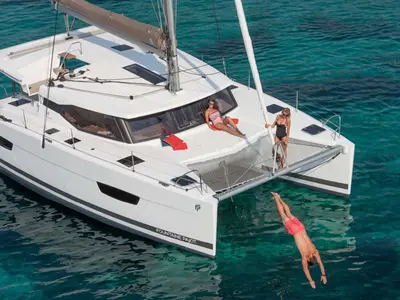

A yacht charter in Greece is really two different holidays, and choosing the wrong one is the mistake first-timers make most often. The Ionian — Lefkada, Corfu, Kefalonia, Meganisi — is a sheltered, forgiving sea where the breeze fills in through the afternoon at about Force 3-4 and the next harbour is an hour or two away. The Aegean is a different country to sail.
From July into August the meltemi comes down from the north-west at Force 5-7 for days at a time, and the Cyclades turn into a passage-planning exercise that experienced crews cross Europe for. Same country, same week, same boat, completely different holiday. Decide which of those two weeks you actually want before you look at a single listing.
When to Go
The season runs May to October. June and September are the sweet spot and it isn't close: the water is warm, the meltemi is a fraction of its August self, the harbours have space at six in the evening, and prices sit well below peak — brokers put the shoulder months at roughly 10-20% under high season, with October cheaper again if you accept the weather risk. July and August buy you the strongest, most reliable wind in the Aegean and the busiest quays in the Mediterranean. May is quiet and cheap, with a real chance of a day where you sit tight and eat well instead of sailing.
Where to Base Yourself
Where you base yourself matters more than which islands you name on the plan, because a charter week is short and you will not go as far as you think. For a first bareboat week, base in the Ionian: Lefkada and Corfu put short, sheltered hops between anchorages and taverna quays within easy reach, and the wind pattern is predictable enough that you can plan a day and have it happen.
Athens and the Alimos marinas open the Saronic — Aegina, Poros, Hydra — which is the gentler side of the Aegean and an honest middle step. Rhodes and Kos serve the Dodecanese, where the sailing is bigger and the islands are further apart. The Cyclades out of Athens or Paros are the ones to earn, not to start with.
Licences and Paperwork
Greece is stricter on paperwork than most Mediterranean charter countries, and this is where bookings come unstuck at the base rather than at the booking. To take a boat bareboat, the person at the helm needs a recognised sailing licence — an ICC or a national equivalent at Day Skipper level or above — and a second crew member has to sign a declaration that they are competent to assist. Both are checked at check-in. If nobody aboard qualifies, nothing is lost: the same boat goes out with a professional skipper, and in the Ionian a good one will show you anchorages that are in no pilot book.
What a Charter Actually Costs
On cost, the headline weekly price is roughly half the story. Across the 2025 season the average weekly bareboat charter in the Greek islands ran about €5,530, and the spread behind that average is enormous: a well-kept Beneteau Oceanis 38.1 in the Ionian is around €2,500 a week in the low season and €4,500 at peak. Bareboat sailing yachts realistically run from about €3,000 in the quiet months to around €11,200 for a peak week; catamarans, which cost more and are worth it if you value space over pointing ability, sit roughly between €6,400 and €17,500.
| Option | Price | Notes |
|---|---|---|
| Monohull (low season) | €3,000 | Bareboat sailing yacht, quiet months |
| Monohull (peak season) | €11,200 | Bareboat sailing yacht, peak week |
| Catamaran (low season) | €6,400 | More space, less pointing ability |
| Catamaran (peak season) | €17,500 | Peak week rate |
Then come the extras that are not optional. A mandatory charter pack — end cleaning, linen, towels, gas, first and last night port fees — is typically €200-€400 on a monohull and €320-€460 on a catamaran. Budget fuel, port fees for the nights in between, and a security deposit or damage waiver. A skipper is around €200 a day plus their food, or about €1,470 for a week on some fleets. We do the arithmetic line by line in the Greece bareboat charter cost breakdown, and the short version is in our answer to how much a yacht charter in Greece costs per week.
One point worth being precise about, because the internet muddles it: on a bareboat charter the VAT is already inside the price you are quoted — Greek fleets publish rates with it included, and say so. The elaborate tax arithmetic you will find online — reduced VAT bands, APA running at 30-40% of the fee, cruising-tax licences — belongs to crewed and large-yacht charters, not to a family taking a 12-metre monohull out of Lefkada. What does apply to you is the cruising tax and the port formalities, and we set out what a bareboat crew actually pays on top in what extra taxes and fees a Greek charter carries.
One piece of advice that saves real money: for four to six adults, a monohull is usually better value than a catamaran. The catamaran is the right call for families with small children, for crews who want to be able to stand up in the shower, and for anyone who dislikes heeling. It is the wrong call if you picked it because it looked bigger in the photos.
Pros
- Monohull is usually better value for 4-6 adults
- Catamaran suits families with small children
Cons
- Catamaran costs more and isn't worth it just for looks
- Monohull heels, which some crews dislike
Bareboat or Skippered?
The bareboat-or-skippered decision comes down to three questions, and only one of them is about money.
- Do you hold the licence?
- Have you sailed this cruising area, or one like it, before?
- Do you actually want to be responsible for the boat on your holiday?
Go bareboat if you can answer yes to all three — the freedom to change the plan at breakfast is the whole point of chartering. Take a skipper if the licence is the blocker, if the meltemi is the reason you chose August, or if you simply want to switch off. Hiring a skipper is also the fastest way to learn a new area properly, and plenty of crews go bareboat the following year off the back of one skippered week.
The First Day
A last thing about the first day, because it worries people more than it should. Check-in is usually around 17:00. In midsummer it stays light until roughly 21:00, so there are about four hours of sailing in hand — but there is no reason to use them all. Out of Lefkada there are good stops within an easy afternoon, and crews who push far on day one are almost always on motorboats. Take the short hop, get the boat sorted, eat ashore, and start the real week in the morning.
What It Comes Down To
Pick the sea that matches your crew, pick the month for the wind you want rather than the school holidays if you possibly can, get the paperwork checked before you pay, and budget the extras honestly. Do that and the week does what a Greek charter is supposed to do — it stops being logistics somewhere around the second morning. We track live availability and real prices across more than 3,000 boats in Greece, so you can compare what is genuinely bookable for your dates rather than working from a brochure rate, and the boats are listed below.