


A yacht charter in Croatia starts from a simple, slightly absurd fact: this small country holds the largest charter fleet in the Mediterranean. Around 3,500 boats sit on our live listing below this guide — more than Greece, more than anywhere — spread along a coast of over a thousand islands where the next good anchorage is rarely more than two hours away. That density is what makes Croatia the easiest place in Europe to turn a week on a boat into a good holiday: short hops, sheltered water, and a marina, buoy field or konoba jetty at the end of every afternoon.
The flip side is that Croatia is organised, and it expects you to be. It is the one major charter country that checks paperwork properly, the one where the marina berth is the big evening expense, and the one where a single named wind — the bora — deserves genuine respect. None of this is difficult; all of it is better known before you book than at the check-in desk.
Popular boats in Croatia

Beneteau Oceanis 35.1 · Bela

Lagoon 40 - 4 + 2 cab · Amalia II

Bali 4.2 · Jackpot
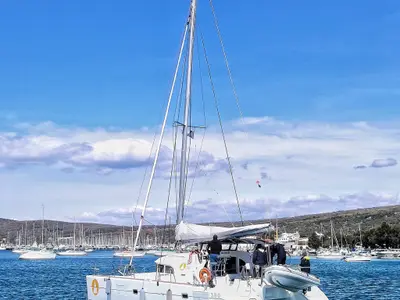
Lagoon 380 · Xenia

Beneteau Oceanis 35.1 · Kolibri

Leopard 44 · What Else
Where to Base Yourself
Croatia's charter coast runs in four blocks, north to south.
Split
Split is the centre of gravity and the right default. The ACI and SCT marinas around Split and Trogir hold the largest concentration of charter boats in the country, and the classic loop — Šolta, Hvar, Vis, the Pakleni islands, back by Brač's Golden Horn — is a week of 8 to 15 mile legs in mostly sheltered water. If it is your first charter, base here and stay inside the islands.
Dubrovnik
Dubrovnik serves the south: the Elaphiti islands, Mljet's national park, and Korčula, with the walled city as your bookend. The legs are slightly longer and the summer crowds in town are real, but the cruising ground is quieter than central Dalmatia once you are off the dock.
Zadar and Šibenik
Zadar and Šibenik are the doorway to the Kornati — a hundred-island archipelago of bare limestone that is the closest the Mediterranean gets to wilderness sailing. The Kornati is a national park with an entry fee, few facilities and unforgettable anchorages; the Krka river and its waterfalls are a day-trip from Skradin at the Šibenik end.
Pula and Istria
Pula and Istria in the north are a different Croatia — Venetian towns, the Brijuni islands, and a gateway to the Kvarner gulf. It suits a second or third visit, and it sits closest to the bora's home ground.
The Sailing Season and the Winds
The season runs May to October, peaking in July and August when every Saturday is changeover day and the popular harbours fill by mid-afternoon. June and September are the sweet spots: warm sea, settled weather, and berths still findable at six in the evening.
Summer's engine is the maestral, a friendly northwesterly that fills in around midday at force 3–4 and dies with the sun — plan mornings under engine or at anchor, afternoons sailing. The wind to respect is the bora, a cold northeasterly that falls off the Velebit mountains in violent gusts, strongest in the Kvarner gulf and the Velebit channel. It is mostly a winter wind and summer episodes are rare and forecast days ahead — but when it is forecast, you stay in port, and no schedule argues with it. The third name, the jugo, is a warm southeasterly that brings humidity, swell and rain, mostly in spring and autumn.
For what this means for an actual week's planning, we keep the full picture in one place. When does the bora wind blow and should it change my sailing plans in Croatia? — the honest answer is in that guide: almost never in July, and yes if it does.
Licences: Croatia Checks
Croatia is stricter than Greece here, and it catches people out. The skipper needs two documents, and the charter base will ask for both at check-in: a recognised licence of competence (an ICC, or a national qualification like RYA Day Skipper), and a VHF radio certificate — the one most first-time visitors have never heard of. Some countries fold radio operation into the sailing licence; if yours does not, you need the separate certificate, and no amount of experience substitutes for the paper.
What licence do I need to charter a bareboat in Croatia? covers the accepted qualifications country by country, including the VHF detail. If you hold neither, nothing is lost — hire a skipper, learn the coast from someone who knows it, and the licence question disappears.
What a Croatia Charter Really Costs
The boat price is the start, not the total. Croatia's extras are predictable — that is the good news — but they are genuinely extra:
- Transit log — an obligatory fee at check-in, typically a few hundred euros a week depending on boat size, covering the charter's permits and paperwork. What is the transit log fee on a Croatia yacht charter and what does it cover? breaks down the current numbers.
- Tourist tax — a small per-person, per-day sojourn tax, usually collected by the base.
- Berths and buoys — the real variable. ACI marina berths in high season are the most expensive evenings of the week; mooring buoys in the bays cost a fraction of that, and anchoring is free. How much do mooring buoys and marina berths cost in Croatia? lays out the per-night figures so you can budget the mix.
- Kornati park entry — if your route goes there, buy the ticket online in advance; it is cheaper than at the kiosk boat.
- Fuel, and an end-cleaning fee on most boats.
A crew that mixes two or three marina nights with buoys and anchorages keeps the week's extras in the hundreds, not thousands — the choice of where you sleep is the biggest cost lever you have.
Bareboat or Skippered
If you hold the licence and the VHF certificate, Croatia is the easiest bareboat country in the Mediterranean — the distances are short, the charts are good and help is never far. If you do not, or you simply want the local knowledge, a skipper turns the same boat into a guided week; expect roughly €150–200 a day plus the skipper's food, and cabins get tighter by one.
Croatia or Greece?
The eternal comparison. Croatia is closer together, better organised and easier to provision; Greece is wilder, windier in the Aegean, and gentler on the wallet once you are off the boat. If you are weighing the two, the Greece hub guide is this page's mirror — same structure, same honesty — and the boats below each guide are live, priced and bookable, so the comparison can be real numbers rather than vibes.